The volume and sophistication of cyberattacks continue to increase rapidly. In 2025, the global number of cyberattacks grew by approximately 44% compared to the previous year, as criminal groups use automation and artificial intelligence to expand the scale and effectiveness of offenses.
This hostile environment occurs as corporate environments have become more distributed and complex: cloud applications, SaaS data, identities outside the traditional perimeter, and third-party integrations expand the attack surface and make it difficult to see what is happening in every layer of the business. Managed detection and response services, such as MDR and MXDR, are clearly expanding, and analysts project that half of organizations will have adopted managed detection services in 2026, as a response to the combination of talent shortages and growing alert volumes.
In this context, the evolution of the SOC, from a reactive and fragmented model to integrated detection and response approaches, is not just a technological trend, but a critical business decision.
The challenge is not “having a SOC,” but containing impact before it escalates
Corporate environments have become distributed by nature. Cloud applications, SaaS data, scattered identities, third-party integrations, and users accessing systems outside the traditional perimeter. The attack follows this logic. It does not happen at a single point, nor does it follow a linear path, and it rarely manifests explicitly at the beginning.
When the organization lacks a mature observation, correlation, and response capability, the incident only becomes visible when the impact has already taken hold. And at that point, the options are always more limited. Therefore, the discussion about SOCs needs to shift to a new level.
When the SOC stops being a structure and becomes a capability
The traditional SOC model was designed for another reality: stable environments, centralized data, and large internal teams dedicated to continuous operation. For many companies, this model simply isn’t viable. But the main point is not to replicate this format.
The evolution of the SOC involves understanding the SOC as a detection and response capability aligned with business risk, regardless of where it is implemented—internally, hybridized, or managed. What matters is responding before the incident propagates.
Where the traditional SOC starts to lose efficiency
In current environments, the classic SOC faces clear limitations.
- Fragmented visibility: Identity, endpoint, network, email, and cloud events are usually analyzed separately. The result is an incomplete reading of the attack’s progression.
- Excessive operational noise: The more disconnected tools there are, the greater the volume of irrelevant alerts. The time spent filtering noise is time missing to investigate what really matters.
- Response time incompatible with the speed of modern attacks: When analysis depends on manual correlation and multiple validations, the attacker has already advanced, created persistence, or expanded the impact.
These limitations are not just technical. They directly translate into operational risk.
XDR as a natural step in the evolution of the SOC
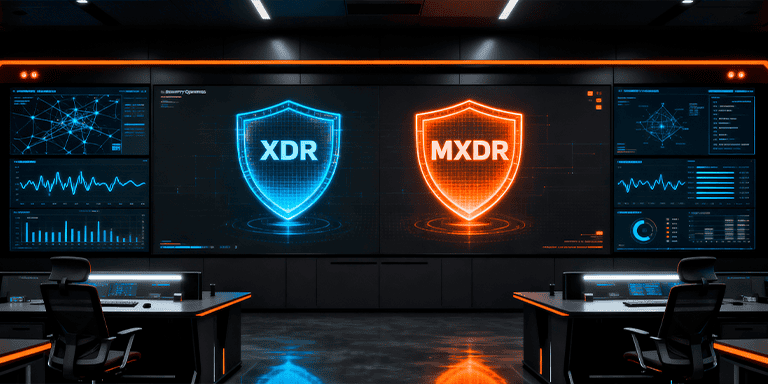
The transition to XDR (Extended Detection and Response) should not be viewed as the adoption of just another tool, but as an advancement in the operational maturity of the SOC. XDR allows correlating signals from multiple layers (identity, endpoint, network, email, and cloud workloads) into a single attack narrative. This changes how incidents are analyzed and prioritized.
Investigation stops being reactive, response gains context, and decision-making becomes faster and more precise. In practice, the SOC stops operating alert by alert and starts working with complete incidents, understanding how the attack started, how it evolved, and where the risk is highest.
MXDR and the reality of leaner IT structures
Even with XDR, many companies hit a critical point: operating security continuously requires method, process, and experience. Something difficult to sustain with only lean internal teams. This is where MXDR (Managed XDR) fits in as part of the SOC’s evolution.
MXDR combines technology with specialized operations, ensuring consistency in incident analysis, investigation, and containment. More than outsourcing, it represents a way to elevate the organization’s response capacity without requiring heavy structures. The focus shifts from “who operates” to “how fast and how well the company can respond”.
The evolution of the SOC as a pillar of operational resilience
When the evolution of the SOC is well conducted, security stops being an isolated function and starts integrating into the organization’s resilience strategy. This is reflected in faster decisions, less downtime, reduced incident propagation, and greater protection of critical data. Incidents cease to be just crises and start generating operational learning. At this stage, security is not just defense. It is stability, predictability, and continuity.
SOC, governance, and the Information Security Policy: the connection that sustains everything
No SOC evolution can be sustained without governance. It is the Information Security Policy that defines what is critical, which risks are acceptable, and who makes decisions in crisis scenarios. Without this alignment, the SOC reacts, but does not sustain. With it, the response gains clarity, predictability, and coherence with the business. The maturity of the SOC is directly linked to the maturity of the governance that guides it.
How Altasnet supports the evolution of the SOC to XDR and MXDR
Altasnet acts by supporting companies in the evolution from reactive models to real detection, response, and governance capabilities, aligned with their operational reality. The focus is not on deploying complex structures, but on building a security operation capable of containing incidents before they become crises, integrating technology, process, and decision-making.
If your operation already depends on cloud and SaaS, the question is not whether incidents will happen, but whether the company can detect and contain them fast enough to avoid real business impact. Altasnet can support this diagnosis and help define the most appropriate next step for your scenario.