The year 2026 marks a structural turning point in the way companies operate technology. For the first time, artificial intelligence, automation, security, and IT architecture definitively converge, creating environments that are much more dynamic and, at the same time, much more complex. According to Gartner, this is the year organizations stop merely adopting technology and start designing natively digital businesses, capable of operating with greater autonomy, resilience, and speed.
This increase in complexity has a direct effect on IT operations. Distributed, hybrid, and multicloud environments start to generate extensive chains of interactions, where a single change can trigger impacts across multiple services, applications, and data flows. Operating without integrated visibility is no longer just a technical challenge and becomes an operational, financial, and reputational risk.
It is in this context that IT observability takes center stage. More than monitoring metrics or availability, it becomes essential to understand the real behavior of the operation, anticipate failures, sustain secure decisions, and ensure control in a scenario where AI exponentially expands the volume, speed, and interdependence of systems.
Why traditional monitoring does not keep up with modern IT
Traditional monitoring was created for predictable, centralized, and stable environments. This model proves insufficient given the current complexity because:
Distributed environments do not fail in isolation: In modern architectures, downtime is rarely linked to a single server or service. It is usually the result of a chain of dependencies between applications, APIs, external services, and infrastructure. Isolated metrics do not explain this cause-and-effect relationship.
Alerts indicate symptoms, they do not explain the problem: Knowing that a service has exceeded a usage limit or become unavailable does not answer the critical questions: what changed, where the problem started, and what the real business impact is if nothing is done.
The speed of change exceeds manual reaction capacity: Frequent deployments, automation, and dynamic scalability cause the environment’s state to change constantly. Traditional monitoring reacts after the impact; modern environments require anticipation.
The difference between seeing metrics and understanding operational behavior
IT observability does not replace metrics, logs, or events. It gives meaning to this data by analyzing it in a correlated and contextualized way. This allows, for example:
Identifying behavior patterns over time: Instead of analyzing isolated events, observability allows understanding what is normal behavior and what represents a relevant deviation, even if it has not yet caused a visible failure.
Relating technical changes to operational impacts: A change in one service might seem harmless in isolation, but generate degradation in another part of the chain. Observability makes this relationship visible before the impact escalates.
Making risk-driven, not urgency-driven decisions: With context, the team can prioritize what truly threatens business continuity, avoiding hasty or misaligned responses.
This change transforms IT operations: from reactive to analytical, preventive, and impact-oriented.
The direct impact of a lack of integrated visibility
Many organizations believe they have control because they accumulate tools, dashboards, and alerts. In practice, this frequently generates a false sense of visibility.
When each IT domain is observed in isolation, the team begins to deal with an excess of alerts, difficulty in prioritization, and fragmented analyses. Incidents repeat themselves because the root causes are not understood, and strategic decisions are made based on assumptions, not evidence.
This scenario directly impacts the business. Downtimes become recurrent, security incidents are detected late, and resources are consumed inefficiently, especially in cloud environments, where a lack of visibility quickly translates into high costs.
Observability as the basis for rapid response and operational resilience
In observable environments, failures and attacks do not emerge as unexpected events. They manifest as progressive behavioral deviations, which can be analyzed and addressed before causing critical impact.
Observability allows you to:
Drastically reduce response time to failures and incidents: The team stops spending time trying to understand what happened and starts acting based on clear correlations and concrete evidence.
Avoid the cascade effect in distributed environments: By quickly identifying the origin of the problem, it is possible to contain failures before they propagate to other services or environments.
Sustain continuity even in adverse scenarios: The organization gains the capacity to absorb failures, attacks, and demand spikes without compromising critical operations.
This model directly strengthens operational and data resilience.
Observability, operational control, and digital sovereignty
In hybrid, multicloud, and SaaS environments, digital sovereignty depends on the ability to understand, audit, and govern your own operation, regardless of the provider. Observability contributes directly to this because it:
Reduces reliance on fragmented vendor views: The organization gains a cross-sectional view of the environment, rather than relying solely on isolated dashboards per platform.
Sustains governance, compliance, and audits: Event and decision traceability makes it possible to explain what happened, when, and why, which is essential in regulatory contexts.
Reinforces strategic IT control: With real visibility, decisions stop being reactive and become structured, based on consistent data.
In this sense, observability becomes an instrument of governance and digital autonomy, not just a technical practice.
Observability is not a tool.
It is a continuous discipline.
Treating observability as an isolated solution is a common mistake. In practice, it must be viewed as a continuous discipline, integrated into IT architecture, security, and operational management. This involves defining what truly needs to be observed, correlating technical signals with business impact, and using this visibility to guide decisions, prioritize investments, and consistently reduce risks. If your operation relies on distributed environments, cloud, SaaS, and critical applications, visibility is not optional, it is strategic. Talk to Altasnet and understand how to structure an IT observability strategy aligned with your business’s resilience, operational control, and digital sovereignty.
The volume and sophistication of cyberattacks continue to increase rapidly. In 2025, the global number of cyberattacks grew by approximately 44% compared to the previous year, as criminal groups use automation and artificial intelligence to expand the scale and effectiveness of offenses.
This hostile environment occurs as corporate environments have become more distributed and complex: cloud applications, SaaS data, identities outside the traditional perimeter, and third-party integrations expand the attack surface and make it difficult to see what is happening in every layer of the business. Managed detection and response services, such as MDR and MXDR, are clearly expanding, and analysts project that half of organizations will have adopted managed detection services in 2026, as a response to the combination of talent shortages and growing alert volumes.
In this context, the evolution of the SOC, from a reactive and fragmented model to integrated detection and response approaches, is not just a technological trend, but a critical business decision.
The challenge is not “having a SOC,” but containing impact before it escalates
Corporate environments have become distributed by nature. Cloud applications, SaaS data, scattered identities, third-party integrations, and users accessing systems outside the traditional perimeter. The attack follows this logic. It does not happen at a single point, nor does it follow a linear path, and it rarely manifests explicitly at the beginning.
When the organization lacks a mature observation, correlation, and response capability, the incident only becomes visible when the impact has already taken hold. And at that point, the options are always more limited. Therefore, the discussion about SOCs needs to shift to a new level.
When the SOC stops being a structure and becomes a capability
The traditional SOC model was designed for another reality: stable environments, centralized data, and large internal teams dedicated to continuous operation. For many companies, this model simply isn’t viable. But the main point is not to replicate this format.
The evolution of the SOC involves understanding the SOC as a detection and response capability aligned with business risk, regardless of where it is implemented—internally, hybridized, or managed. What matters is responding before the incident propagates.
Where the traditional SOC starts to lose efficiency
In current environments, the classic SOC faces clear limitations.
Fragmented visibility: Identity, endpoint, network, email, and cloud events are usually analyzed separately. The result is an incomplete reading of the attack’s progression.
Excessive operational noise: The more disconnected tools there are, the greater the volume of irrelevant alerts. The time spent filtering noise is time missing to investigate what really matters.
Response time incompatible with the speed of modern attacks: When analysis depends on manual correlation and multiple validations, the attacker has already advanced, created persistence, or expanded the impact.
These limitations are not just technical. They directly translate into operational risk.
XDR as a natural step in the evolution of the SOC
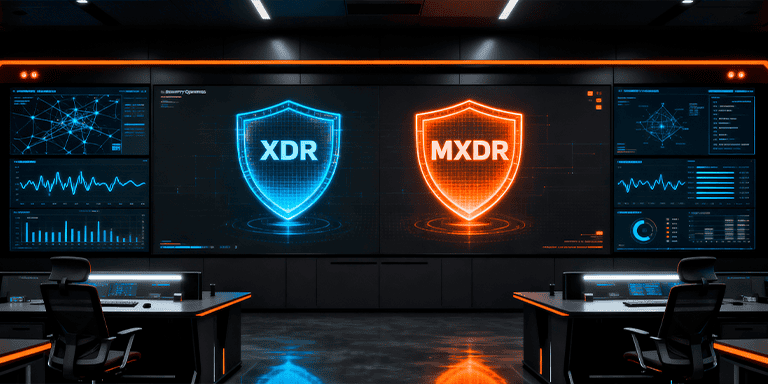
The transition to XDR (Extended Detection and Response) should not be viewed as the adoption of just another tool, but as an advancement in the operational maturity of the SOC. XDR allows correlating signals from multiple layers (identity, endpoint, network, email, and cloud workloads) into a single attack narrative. This changes how incidents are analyzed and prioritized.
Investigation stops being reactive, response gains context, and decision-making becomes faster and more precise. In practice, the SOC stops operating alert by alert and starts working with complete incidents, understanding how the attack started, how it evolved, and where the risk is highest.
MXDR and the reality of leaner IT structures
Even with XDR, many companies hit a critical point: operating security continuously requires method, process, and experience. Something difficult to sustain with only lean internal teams. This is where MXDR (Managed XDR) fits in as part of the SOC’s evolution.
MXDR combines technology with specialized operations, ensuring consistency in incident analysis, investigation, and containment. More than outsourcing, it represents a way to elevate the organization’s response capacity without requiring heavy structures. The focus shifts from “who operates” to “how fast and how well the company can respond”.
The evolution of the SOC as a pillar of operational resilience
When the evolution of the SOC is well conducted, security stops being an isolated function and starts integrating into the organization’s resilience strategy. This is reflected in faster decisions, less downtime, reduced incident propagation, and greater protection of critical data. Incidents cease to be just crises and start generating operational learning. At this stage, security is not just defense. It is stability, predictability, and continuity.
SOC, governance, and the Information Security Policy: the connection that sustains everything
No SOC evolution can be sustained without governance. It is the Information Security Policy that defines what is critical, which risks are acceptable, and who makes decisions in crisis scenarios. Without this alignment, the SOC reacts, but does not sustain. With it, the response gains clarity, predictability, and coherence with the business. The maturity of the SOC is directly linked to the maturity of the governance that guides it.
How Altasnet supports the evolution of the SOC to XDR and MXDR
Altasnet acts by supporting companies in the evolution from reactive models to real detection, response, and governance capabilities, aligned with their operational reality. The focus is not on deploying complex structures, but on building a security operation capable of containing incidents before they become crises, integrating technology, process, and decision-making.
If your operation already depends on cloud and SaaS, the question is not whether incidents will happen, but whether the company can detect and contain them fast enough to avoid real business impact. Altasnet can support this diagnosis and help define the most appropriate next step for your scenario.
For a long time, the Information Security Policy (ISP) was treated as a formal document, created to meet regulatory requirements or to be presented during audits. Produced, approved, and filed away, it rarely played a part in day-to-day decisions.
Today, critical data circulates between the cloud, SaaS applications, partners, vendors, and remote users. Information moves rapidly, crossing technical and organizational boundaries, and sustaining essential business processes.
The absence of clear guidelines generates not only security flaws but also compromises decision-making, amplifies operational risks, and weakens incident response capabilities.
The information security policy, therefore, takes on a different role: that of an instrument of governance and digital resilience, capable of sustaining control even in distributed environments.
Why the Information Security Policy Has Become Indispensable
Modern corporate environments operate as ecosystems. Identities, access, applications, and data connect in dynamic ways, often outside the direct control of the IT department.
When rules are unclear, decisions are made in isolation, based on urgency or individual interpretation.
This is where silent conflicts arise: access granted without criteria, data shared beyond what is necessary, and integrations performed without risk assessment. The problem is not just technical; it is the lack of a common reference point.
The information security policy exists to reduce ambiguity. It creates predictability, guides decisions, and establishes clear limits so that operations function consistently, even when the environment changes or an incident occurs.
Information Security Policy: What It Is and Its Real Role
The information security policy defines how the organization protects, uses, and controls its information. However, its value lies not in the definition itself, but in how it guides organizational behavior.
In practice, the ISP functions as an institutional agreement. It establishes who can access specific data, under what conditions, with what responsibilities, and how far decisions can go in risk scenarios.
Without this agreement, each department tends to act based on its own priorities, which weakens control and increases exposure.
When well-structured, the ISP does not stifle operations. It offers a balance between protection and continuity, allowing decisions to be made quickly, but within clear boundaries.
Where Many Security Policies Fail
Most ISPs fail not due to a lack of intention, but due to a disconnection from operational reality. Generic documents, copied from ready-made templates, often ignore the intensive use of cloud, SaaS, and third parties.
Other policies may be technically correct but are excessively rigid, making them impractical for daily use.
There are also policies that fail to clarify who decides, who executes, and how to act when something unexpected occurs. In these situations, the policy exists but does not guide decisions. Consequently, when an incident happens, it is not consulted because it was not built for that scenario.
An effective ISP needs to reflect the organization’s real environment, its risks, and its way of operating.
ISP as a Basis for Resilience and Incident Response
Security incidents rarely escalate due to a lack of technology. They escalate when the organization does not know clearly how to react. When an event occurs, the doubts are not technical; they are organizational.
Who can isolate a system?
Who authorizes the suspension of access?
Which data is priority?
How far can a containment action go without compromising operations?
The information security policy answers these questions before the incident happens. By defining responsibilities, criteria, and limits, the ISP sustains response capabilities and reduces decisions made under pressure.
In this sense, it becomes one of the pillars of digital resilience, connecting prevention, reaction, and business continuity.
ISP and Digital Sovereignty in Distributed Environments
As data transits between the cloud, partners, and external applications, control over information ceases to be automatic. Digital sovereignty becomes dependent on clear rules.
The ISP is the instrument that defines where data can reside, how it can be accessed, under what conditions it can be shared, and what happens when these limits are crossed.
Without these guidelines, the organization loses control not only over its data but over its own decisions in complex digital environments.
In this context, the information security policy acts as a mechanism for preserving organizational autonomy, even when the infrastructure is not entirely under internal control.
The Role of IT Leadership in a “Living” ISP
An information security policy does not sustain itself. It requires leadership, continuous review, and alignment with business strategy.
It is up to IT leadership to ensure that the ISP keeps pace with changes in the technological environment, new integrations, new work models, and new risks. When treated as static, the policy ages quickly. When treated as a continuous process, it remains relevant and applied.
The maturity of the ISP is directly linked to how leadership incorporates it into strategic and operational decisions.
Aligning the ISP with Cloud, SaaS, Hybrid Environments, and Third Parties
A modern ISP needs to explicitly reflect the use of cloud services, SaaS applications, and third-party involvement. Ignoring these elements creates gaps that are difficult to justify during incidents or audits.
At the same time, the policy cannot block innovation. Its role is to create clear limits so that innovation occurs with control, defining responsibilities, minimum security requirements, and access criteria for everyone involved.
When this balance is achieved, the ISP ceases to be seen as an obstacle and becomes a facilitator of safer decisions.
How Altasnet Supports the Construction of Effective Security Policies
If your operation already relies heavily on cloud, SaaS, and third parties, the central question is not whether the policy exists, but whether it actually guides decisions when the scenario changes or an incident occurs.
Altasnet works to support companies that need to transform their information security policy into a practical instrument of governance and control.
Our work involves understanding the environment, data flows, risks, and the organization’s operational maturity to structure an applicable ISP—aligned with business reality and integrated with other security layers.
Speak with our experts right now to get a complete diagnosis and discover the next steps to evolve your security policy consistently and sustainably.
Information security is no longer a topic restricted to the technical department; it has moved to occupy a central place in organizations’ strategic decisions. As reliance on technology grows, so do the operational, regulatory, and reputational risks associated with security failures.
In this context, IT governance gains prominence. It is not just about defining controls or complying with standards, but about establishing clear guidelines, responsibilities, priorities, and decision-making mechanisms that connect security, technology, and the business.
With increasingly distributed environments, intensive data usage, the advancement of artificial intelligence, and greater regulatory pressure, information security governance is entering a new maturity cycle. This article analyzes the main trends shaping this evolution and shows how organizations can prepare for this scenario in a structured and sustainable way.
What is Information Security Governance?
Information security governance is the set of policies, processes, structures, and responsibilities that guide how security is planned, implemented, monitored, and improved within the organization.
Unlike operational security (focused on executing technical controls), governance operates at a broader level, ensuring that:
Security decisions are aligned with business strategy;
Risks are known, prioritized, and accepted consciously;
Roles and responsibilities are well-defined;
Metrics and indicators guide decision-making.
Within IT governance, information security ceases to be reactive and becomes driven by clear objectives, integrating risk, compliance, continuity, and business growth.
Why IT Governance Has Gained Prominence
The strengthening of security governance is not an isolated trend, but a direct response to transformations in the digital environment. Among the main factors driving this movement are:
Expansion of the attack surface, with hybrid environments, cloud computing, and remote access;
Growing financial and reputational impact of security incidents;
Stricter regulatory requirements, demanding traceability and evidence;
Greater leadership accountability, requiring executives to answer for decisions related to digital risk.
In this scenario, IT governance becomes essential to avoid fragmented decisions, align priorities, and ensure that security is treated as part of the corporate strategy, rather than just an operational cost.
Key Trends in Information Security Governance
Security governance evolves to keep pace with the complexity of the digital environment. Several trends are already consolidating as fundamental for the coming years.
Risk-Oriented Governance
Prioritization based solely on technical requirements is losing ground to an approach oriented toward real business risk. Decisions now consider financial, operational, and reputational impacts, rather than just isolated vulnerabilities. This shift strengthens IT governance as a strategic risk management instrument.
Integration Between Governance, IT, and Corporate Strategy
Security stops operating in parallel and begins to participate actively in strategic planning. Governance assumes the role of a bridge between technology, risk, and business objectives, promoting more mature and aligned decisions.
Regulatory Pressure and Executive Accountability
The advancement of regulations expands the need for well-defined controls, documentation, and evidence. Security governance begins to protect not only systems and data but also the organization and its leadership by ensuring clarity regarding responsibilities and decision-making processes.
Use of Data, Metrics, and Automation to Support Decisions
Modern governance is increasingly data-driven. Risk indicators, executive dashboards, and the automation of monitoring processes help transform technical information into strategic inputs for leadership. Automation supports governance by reducing operational effort and expanding analytical capacity.
Continuous and Adaptive Governance
Models based only on periodic audits are becoming insufficient. The trend is toward continuous, dynamic, and adaptive governance capable of evolving as the environment, risks, and business change.
Essential Components of Good IT Governance
To sustain these trends, IT governance needs to be supported by several fundamental pillars:
Clear definition of roles and responsibilities;
Policies aligned with business strategy;
Structured risk management;
Actionable indicators and metrics;
Integration between IT, security, and business areas;
Continuous review and improvement cycles.
These components help transform security governance into a living process aligned with the organization’s maturity.
How to prepare IT Governance for the Coming Years
Preparation involves fewer point-changes and more structural evolution. A practical path involves:
Evaluating the current governance model and its limits;
Identifying priority risks and control gaps;
Integrating security into the corporate strategy;
Defining clear risk and performance indicators;
Establishing continuous review and improvement cycles.
This movement strengthens governance as a foundation for safer and more sustainable decisions.
IT Governance as a Strategic Security Pillar
The trends make it clear that information security governance is a strategic pillar of IT governance, essential for protecting the business, sustaining growth, and responding to an increasingly complex digital environment.
Organizations that invest in mature governance gain greater clarity, predictability, and decision-making capacity, transforming security into a strategic advantage.
Altasnet supports companies in structuring and evolving IT governance, combining cybersecurity solutions, risk management, and protection of critical environments, always with a consultative approach aligned with each organization’s maturity.
IT infrastructure should not just be part of operational support; it should be one of a company’s primary strategic assets. As data, applications, and processes become more distributed, security must evolve at the same pace—no longer as isolated solutions, but as an integral part of the technological architecture.
Hybrid environments, cloud workloads, multiple access points, and third-party integrations significantly expand the attack surface. In this reality, fragmented approaches create gaps that are difficult to identify and even harder to manage.
This is exactly where the concept of integrated security in IT infrastructure comes in. In this article, you will understand what integrated security is, why this approach is essential for modern IT infrastructure, and how to implement it in a structured and effective way.
What is Integrated Security in IT Infrastructure?
Integrated security is a model that connects different layers of protection—logical, digital, operational, and procedural—into a single, coordinated, and continuous strategy. Instead of isolated tools, the focus is on the integration between systems, processes, and people.
This means that protection mechanisms work in a synchronized manner, sharing information, correlating events, and responding to incidents jointly, thereby reducing failures and blind spots.
When applied to IT infrastructure, this approach involves the integration of:
Networks, servers, and data centers;
Cloud and multi-cloud environments;
Endpoints, identities, and access;
Policies, monitoring, and incident response.
In practice, security becomes part of the IT architecture design, and not just its operation.
Why Adopt Integrated Security in IT Infrastructure
The adoption of integrated security addresses three central challenges faced by organizations today:
Increased Environment Complexity: Modern IT infrastructure is distributed, dynamic, and highly connected. This makes it impossible to protect each component in isolation without losing visibility and control.
Evolution of Threats: Attacks are increasingly automated, persistent, and targeted. Fragmented strategies hinder early detection and amplify the impact of incidents.
Need for Faster and More Efficient Response: Integrated security allows for the correlation of data across different layers of IT infrastructure, reducing the time between detection, analysis, and response.
Broad corporate security approaches emphasize that protecting systems and data requires a holistic view of the technological environment, considering the entire IT chain rather than just point controls.
Essential Components of an Integrated Security IT Infrastructure
For integrated security to function effectively, several pillars must be well-structured within the IT infrastructure:
Governance and Security Policies: Clear guidelines aligned with business objectives and applicable to the entire environment.
Segmented Network Architecture: Reduction of lateral movement and containment of threats.
Identity and Access Management (IAM): Strict control of permissions, authentication, and privileges.
Continuous Monitoring and Event Correlation: Centralized visibility to identify anomalous behavior.
Endpoint and Workload Protection: Consistent security across physical, virtual, and cloud environments.
Backup, Recovery, and Operational Resilience: The ability to restore services quickly and predictably.
User Awareness and Training: People as an active part of the security strategy.
When integrated, these elements strengthen the security posture and reduce operational risks.
How to Implement Integrated Security in Your IT Infrastructure
Implementation should be planned and progressive, avoiding disruptions and ensuring maturity over time. A practical model involves the following steps:
Diagnosis of the Current Environment: Complete mapping of IT infrastructure, assets, data flows, risks, and dependencies.
Definition of Security Objectives: Aligning security with business needs, regulatory requirements, and operational priorities.
Risk and Gap Analysis: Identifying where security is fragmented or insufficient.
Integrated Architecture Planning: Designing an architecture that connects technologies, processes, and teams.
Selection of Interoperable Solutions: Prioritizing tools that integrate and share information.
Gradual Implementation: Starting with critical environments and evolving continuously.
Monitoring, Metrics, and Continuous Improvement: Tracking risk indicators, performance, and security effectiveness.
In the integration between security and IT, convergence must be part of the corporate strategy, avoiding isolated decisions misaligned with the business.
Practical Examples of Integrated Security
In corporate environments, integrated security in IT infrastructure allows for:
Detecting threats before they cause operational impact;
Reducing incident response time;
Minimizing failures resulting from a lack of visibility;
Increasing the reliability of IT services.
These benefits are especially relevant in critical operations, regulated environments, and companies that depend on high data availability and integrity.
Altasnet Supports the Evolution of Your IT Infrastructure with Integrated Security
Building a secure, integrated IT infrastructure prepared for hybrid and cloud environments requires more than isolated tools. It requires strategy, a well-defined architecture, and an operation aligned with real business risks.
Altasnet supports companies in structuring integrated security by combining cybersecurity solutions, governance, monitoring, and protection of critical environments with a consultative approach tailored to each organization’s maturity.
If your company needs to evolve its IT infrastructure security consistently and strategically, speak with Altasnet experts and learn how to structure this model in practice.
In boardrooms and executive meetings, a new topic has dominated the agenda: cybersecurity. It is no longer just a technical responsibility; it is a strategic imperative. CEOs, CFOs, and directors are acutely aware that a cyberattack can lead to severe consequences: operational downtime, financial losses, reputational damage, and even loss of market share.
According to a study by Fortinet, the average global cost of a data breach exceeds $3.7 million. However, companies that adopt advanced security practices—such as AI-driven detection and managed services – can reduce this impact to approximately $814,000.
Despite this, many leaders still face a challenging reality:
A lack of visibility into the true state of their information security.
Difficulty in assessing digital risks through measurable data.
Internal teams that are either overwhelmed or lack maturity in cybersecurity.
Uncertainty regarding the return on investment (ROI) in the security sector.
In this landscape, Managed IT Services emerge as strategic allies for senior leadership.
How Managed IT Services Reduce Business Risks
Comprehensive Visibility of the Digital Environment
Managed services provide continuous monitoring of assets, users, and critical events. This empowers senior management to make decisions based on real-time data regarding vulnerabilities, flaws, and imminent risks.
Technical Depth Focused on Results
By partnering with third-party security specialists, companies gain access to advanced knowledge, consolidated methodologies, and faster response times—without the need to build and maintain massive internal teams.
Predictable Costs and Scalability
CFOs and COOs find immense value in service models with predictable costs, defined SLAs (Service Level Agreements), and a scope that adjusts according to the company’s growth or digital transformation.
Compliance and Governance
Regulations such as the LGPD (Brazil’s General Data Protection Law) require well-structured policies and auditable processes. Managed services help ensure continuous compliance, avoiding fines and legal issues—a critical assurance that leadership must provide to the board and stakeholders.
Reduced Exposure and Business Continuity
Companies with continuous support experience less exposure to attacks, shorter downtime during incidents, and a higher recovery capacity. This directly impacts strategic performance indicators.
Key Indicators for Senior Leadership to Monitor
To align security with business objectives and justify investments, executives should track:
MTTD & MTTR: Mean Time to Detect and Mean Time to Respond to incidents.
Blocked Intrusion Attempts: The volume of threats neutralized before impact.
Compliance Rate: Adherence to internal security policies and external regulations.
SLA Adherence: The provider’s performance against agreed service levels.
The Strategic Role of Altasnet
Altasnet provides Managed IT Services with a core focus on corporate cybersecurity. We act as an extension of your internal team, combining advanced tools, threat intelligence, and a consultative approach.
Our mission is to transform cybersecurity into a competitive advantage, rather than a blind spot in executive management.
Does your company have real control over its digital risks?
Contact Altasnet and discover how to transform cybersecurity into a growth strategy with Managed IT Services tailored to your business needs.